
Which is fair enough. No one sits around on a Sunday afternoon saying, “You know what I’d love to unpack today? Tax law around super death benefits.”
But this is one of the biggest traps in SMSF and estate planning.
Because while Australia doesn’t have old-school death duties, super can still be taxed when it’s paid out after death. And in an SMSF, the tax result depends on who gets the money, how it’s paid, and what makes up the balance.
Trustees also need to deal with the fund rules, the deed, the nomination, and the tax treatment, all at the same time. Very simple. Very relaxing.
A lot of families assume super just flows through the Will like the house, the shares, or the good dining table nobody actually wants but everyone feels weird about selling.
It doesn’t.
Super sits outside the estate unless it is paid to the legal personal representative, and in an SMSF the trustee has to make sure the death benefit is paid in line with the trust deed and super law. If there is no valid binding nomination, the remaining trustees may end up deciding where the benefit goes.
That is where things can go sideways.
Because the tax outcome is not based on who the family thinks should get the money. It is based on who qualifies under the rules.
If a super death benefit is paid to a dependant for tax purposes, a lump sum is generally tax-free.
If it is paid to someone who is not a death benefits dependant for tax purposes, the taxable component can be taxed. The ATO says the taxable component paid to a non-dependant can be taxed at 15% on the taxed element and 30% on the untaxed element, with the estate broadly taxed the same way it would have been if paid directly to the beneficiary.
And here’s the bit that catches families all the time:
That surprises people, mainly because “my child” feels like a fairly strong relationship.
Tax law, however, prefers to make things weird. In practice, adult children who are financially independent are often treated as non-dependants for tax purposes, which means part of the super death benefit can be taxed on the way out.
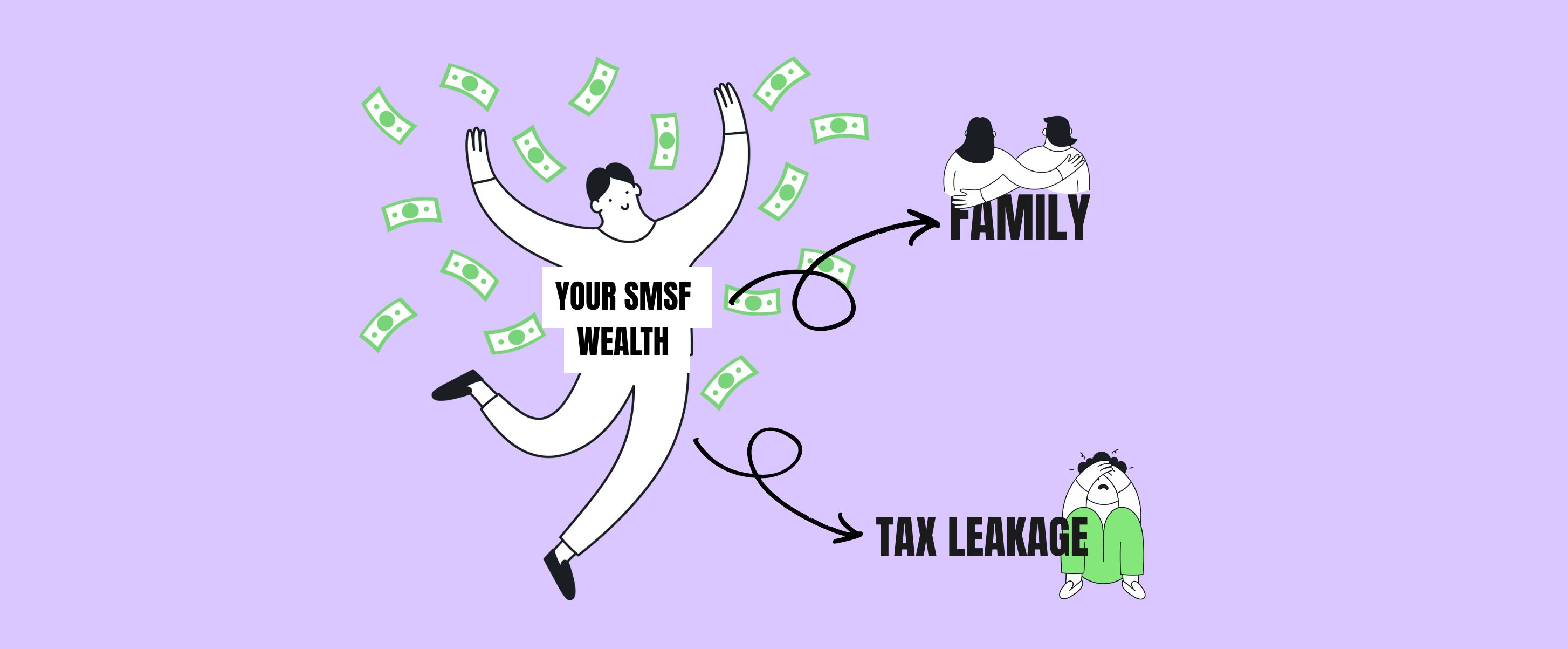
So yes, a family can spend decades building wealth in the most tax-effective structure available, only to lose a chunk of it at the final handover because the wrong person received the wrong component in the wrong way.
A very Australian outcome, really.
This problem hits harder in SMSFs because the balances are often larger, the structures are more tailored, and the assets inside the fund are usually part of a bigger family wealth plan.
That means one sloppy piece of death benefit planning can do a surprising amount of damage.
The common traps usually look like this.
This is the big one.
Parents assume their super will eventually go to the kids tax-free because it is “family money”. But if those children are adults and not tax dependants, the taxable component of the death benefit can attract tax. For larger SMSF balances, that is not a cute little technical issue. That is real money walking out the door.
People often think the Will is the master document and everything else just politely follows along.
Super does not always play that game.
The ATO makes clear that trustees need to consider the trust deed, super law, and any binding or non-binding nomination. Without a binding nomination, the remaining trustees decide how the benefits are distributed, subject to the fund rules and the law.
So if the Will says one thing, but the SMSF deed and nominations say something else, you can end up with conflict, delay, and the sort of family meeting that permanently ruins Christmas.
Paying the super death benefit to the estate can be the right move in some cases. It can help with control and allow the Will to direct who ultimately benefits.
But it does not automatically wipe out the tax problem.
The ATO says that where a super death benefit is paid to the trustee of a deceased estate, it is taxed within the estate in the same way it would be taxed if it had been paid directly to the beneficiary. So if the ultimate beneficiary is a non-dependant for tax purposes, the taxable component can still be taxed.
In other words, the estate can change the path. It does not necessarily change the tax.
This is the quiet killer.
A super benefit is made up of tax-free and taxable components, and under the proportioning rule those proportions generally carry through to the benefit being paid. That means two members can have exactly the same total balance but very different tax outcomes on death depending on what sits inside the account.
That is why death benefit planning is not just about the balance.
It is about the ingredients.
Same size pie. Very different filling. One leaves the family well looked after. The other leaves the ATO unreasonably pleased with itself.
This is where the conversation gets more interesting.
In some cases, part of the planning opportunity is not just deciding who gets the super. It is improving what they are receiving.
One strategy advisers sometimes use is a recontribution strategy. In simple terms, it involves withdrawing super that a member is eligible to access and recontributing it back to super, usually as a non-concessional contribution. Done properly, that can increase the tax-free component and reduce the taxable component over time, which may improve the eventual tax outcome where adult children or other non-dependant beneficiaries are likely to inherit. This is widely used in estate planning discussions for exactly that reason, although eligibility, contribution caps, age rules and timing all matter.
Now, this is not a magic trick and it is definitely not a “read one article and have a crack on Tuesday” strategy.
It needs proper advice.
But for the right client, it can be one of those deceptively simple moves that quietly saves a serious amount of tax later on.
Which is usually the good kind of boring.
A lot of estate planning looks fine at the first level.
Spouse dies, benefits move to surviving spouse, everyone nods, job done.
Maybe.
A spouse is generally a dependant for tax purposes, and dependants can receive a death benefit as a lump sum or an income stream, while non-dependants can only receive a lump sum. That often makes the first death much cleaner from a tax perspective.
But if the surviving spouse later dies and the super eventually goes to financially independent adult children, the tax issue may simply be delayed, not solved.
That is why good SMSF death benefit planning is not just about what happens first.
It is about where the money ends up in the end.
This is the practical bit. The useful bit.
The bit worth doing before anyone is stressed, grieving, or hunting for the trust deed in a drawer full of printer cables and expired warranties.
1 - Review the deed and nominations
Make sure the trust deed is current and that any death benefit nomination is valid and consistent with it. In SMSFs, the deed matters, and the ATO specifically points trustees back to the deed and super law when a member dies.
2 - Work out who the likely beneficiaries are for tax purposes
Do not assume “adult child” means tax-free. Check who would actually qualify as a death benefits dependant for tax purposes, because that changes the outcome materially.
3 - Understand the components of the balance
You need to know how much of the member balance is tax-free and how much is taxable. Without that, it is impossible to estimate the real tax risk
4 - Model the end game, not just the first step
For many wealth clients, the real issue is not whether the spouse can receive the benefit efficiently. It is whether the family can stop unnecessary tax when the next generation eventually receives it. The first death is often the easy part. It is the second one that bites.
5 - Ask whether a recontribution strategy is worth exploring
Not everyone can do it. Not everyone should. But where the numbers, ages and contribution rules line up, it can be a very effective way to reduce the taxable portion of a balance and improve the eventual outcome for adult children. That is exactly why it is worth reviewing before it becomes urgent.
Building wealth in super is only half the job.
The other half is making sure it does not leak out through avoidable tax when that wealth eventually moves to the next generation.
For SMSF families, this is one of the most overlooked planning issues around. Not because the rules are impossible, but because they sit in that dangerous category of things people assume someone else has sorted.
Sometimes they have. Sometimes they absolutely have not. And that is the problem.
A good death benefit plan can preserve family wealth quietly and efficiently in the background. A bad one can hand a lump of it back to the ATO because nobody checked the deed, the nomination, the tax components, or whether a recontribution strategy could have improved the result.
Which is a fairly brutal way to discover that estate planning is not just about who gets the money. It is also about how much is left when they do.
If you have an SMSF and want to make sure more of your super ends up with your family and less of it disappears in tax, let’s have a conversation. We can help you review your death benefit planning and spot opportunities before they are gone.
– The team at PAL (making accounting slightly less boring since way back when)
Disclaimer: This article is here to give you general info only, not professional advice specific to your unique situation. While efforts are made to ensure accuracy, the content may change over time. We can’t take responsibility for any decisions based on the contents of this article, so be sure to chat with your accountant or advisor first!
.jpg)
.jpg)
.png)
.png)